
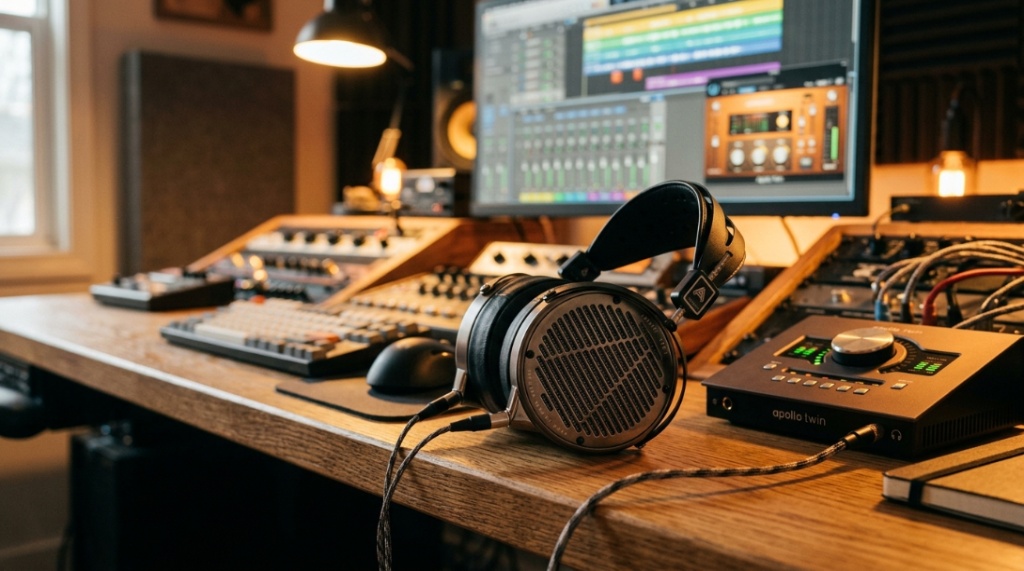
If your mix sounds amazing on your headphones but falls apart on car speakers, phone speakers, and your friend’s Bluetooth speaker—your headphones are lying to you. They’re telling you what you want to hear, not what’s actually there. Every bass boost, every treble sparkle, every scooped mid that makes casual listening fun is actively misleading your mix decisions.
You’ve been EQing to compensate for your headphones’ color without realizing it. Boosting bass that’s already there because your cans roll it off. Cutting treble is fine because your headphones hype the highs. Adding low-mid content to fill what feels thin—creating mud that only reveals itself on neutral systems. Your mixes don’t translate because your monitoring reference doesn’t tell the truth.
Reference headphones exist to solve this. They’re designed with one purpose: accurate sound reproduction—showing you exactly what’s in your audio without adding, subtracting, or flattering anything. What goes in is what comes out. No opinions, no colorations, no lies. This guide helps you understand what reference monitoring actually means, how to choose the right pair, and how to use them effectively for mixes that translate everywhere.
What Does “Reference” Actually Mean in Headphones?
The term “reference” gets thrown around loosely in marketing. Here’s what it genuinely means in professional audio:
Flat frequency response: The headphone reproduces all frequencies at equal perceived loudness (within ±3 dB from 20 Hz to 20 kHz). No frequency range is artificially emphasized or reduced. Bass, mids, and treble arrive at your ears in the same proportions they exist in the source material.
Minimal harmonic distortion: Reference headphones produce the original signal without adding their own harmonics. A Total Harmonic Distortion (THD) under 0.1% across the audible range means what you hear is the recording—not the headphone adding its own warmth or grit.
Accurate transient response: The drivers start and stop precisely when the signal tells them to. No overshoot (ringing after sharp sounds), no sluggish response (smearing of fast transients). A drum hit sounds like a drum hit — with its exact attack shape and natural decay, not a softened, rounded version.
Consistent imaging: Stereo information is presented accurately. Elements planned for 30% left appear at 30% left—not 20% or 45%. This precision allows you to make spatial mix decisions that translate correctly to other playback systems.
What reference does NOT mean: It doesn’t mean “sounds best.” Reference headphones often sound less exciting than consumer models because they don’t flatter the audio. Music through reference cans can sound surprisingly “boring” at first—that’s not a flaw, it’s honesty.
Why Does Accurate Sound Reproduction Matter for Mixing and Mastering?
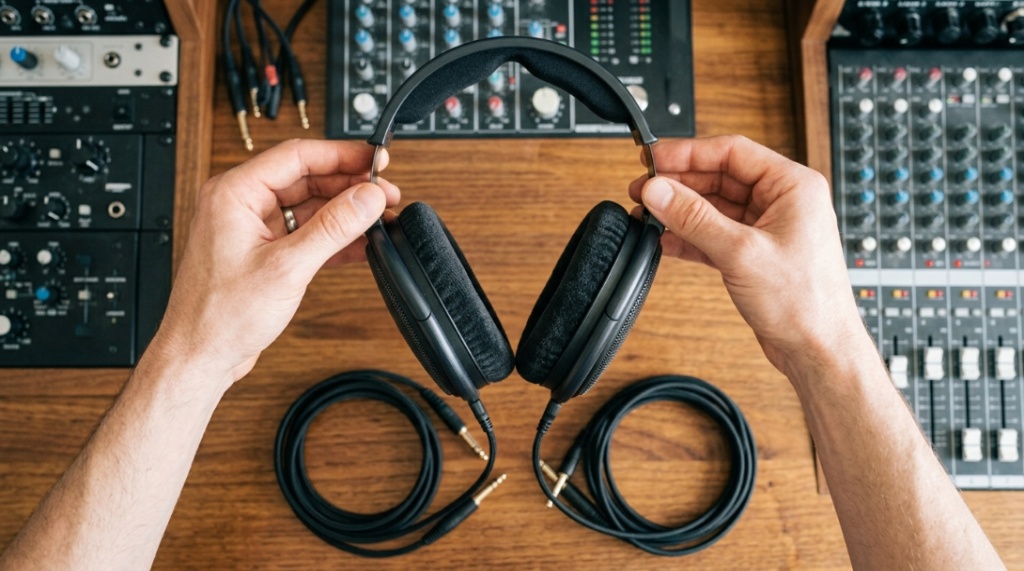
Every mix decision you make is based on what you hear. If what you hear is wrong, your decisions compensate for problems that don’t exist (or miss problems that do):
Bass-heavy headphones → thin mixes: If your headphones boost bass, your mix sounds bass-heavy to you. You cut bass to “fix” it. On neutral systems, your mix is now thin and lacks body. You’ve removed bass that was correct because your headphones made it seem excessive.
Treble-bright headphones → dull mixes: Hyped highs make everything sound crisp. You reduce treble that “feels too much.” Result: muddy, dark mixes on every other system because you cut clarity that was appropriate.
Scooped-mid headphones → harsh mixes: Missing midrange makes you boost it to compensate. But the midrange was already correct — your headphones just weren’t reproducing it. The final mix has excessive mid-presence that sounds harsh and fatiguing on flat systems.
Poor transient accuracy → over-compressed mixes: Headphones that soften transients make your dynamics sound weaker than they are. You add more compression to “punch things up.” The result is an over-compressed mix that sounds lifeless on accurate systems.
Reference headphones eliminate all of these cascading errors. When you hear truth, you make correct decisions. Correct decisions produce mixes that sound good everywhere—not just on your cans.
What Specifications Define True Reference Headphones?
Look for these measurable characteristics when evaluating reference claims:
| Specification | Consumer Standard | Reference Standard | Why It Matters |
|---|---|---|---|
| Frequency Response Deviation | ±10-15 dB | ±3 dB (20 Hz-20 kHz) | Flatter = more truthful across all frequencies |
| Total Harmonic Distortion | 1-5% | Under 0.1% (ideally 0.02%) | Lower = cleaner, no added harmonics |
| Impulse Response | Slow, ringing | Fast, minimal overshoot | Accurate transient reproduction |
| Channel Matching | ±3-5 dB | ±0.5-1 dB | Accurate stereo imaging |
| Driver Type | Dynamic (basic) | Dynamic (premium) or Planar Magnetic | Better linearity and control |
Which Reference Headphones Deliver Genuine Accuracy?
Not every headphone marketed as “reference” deserves the title. These models have been independently measured and verified as genuinely flat:
Sennheiser HD 600—$250-300 (Open-Back)
The industry reference standard for 25+ years. The HD 600 has been used to master more albums than arguably any other headphone. Its midrange is exceptionally neutral — what mastering engineers call “boring in the best way.” Slight roll-off below 40 Hz and above 12 kHz prevents it from being perfectly ruler-flat, but its mid-frequency accuracy is legendary. Impedance: 300 ohms (needs amplification).
Sennheiser HD 650/HD 6XX — $200-350 (Open-Back)
The HD 600’s sibling with slightly warmer low-mids and softer treble. Some engineers prefer this for long mixing sessions, as it’s marginally less fatiguing while maintaining excellent accuracy. The HD 6XX (Drop collaboration) offers identical performance at a lower price. Impedance: 300 ohms.
Beyerdynamic DT 1990 Pro — $350-450 (Open-Back)
Tesla drivers deliver exceptional resolution and transient accuracy. Two pad sets are included: analytical pads (flatter response) and balanced pads (slight warmth). The DT 1990 reveals micro-details that lesser headphones simply can’t reproduce—differences between compressor settings, subtle EQ moves, and spatial nuances become obvious. Impedance: 250 ohms.
AKG K712 Pro — $200-300 (Open-Back)
Wide, natural soundstage that approaches speaker-like presentation. Excellent for spatial mixing decisions — reverb tails, panning, and depth placement are easy to judge. Slightly less neutral in the bass region than the HD 600 but compensates with superior imaging. Impedance: 62 ohms (drives from most interfaces).
Audeze LCD-X — $1,000-1,200 (Open-Back, Planar Magnetic)
The reference standard for those who can justify the investment. Planar magnetic drivers deliver essentially zero distortion, ruler-flat response (2021+ revision), and transient accuracy that reveals everything. Used in major mastering studios worldwide. Heavy (612g), but the sound quality justifies the weight for critical work. Impedance: 20 ohms (easy to drive).
Austrian Audio Hi-X65 — $350-400 (Open-Back)
Newer entrant from former AKG engineers. Designed specifically as a mixing/mastering reference with measured linearity rivaling headphones twice the price. Clean, neutral, and impressively revealing for the price point. Impedance: 25 ohms (universal compatibility).
Open-Back vs. Closed-Back: Which Is Better for Reference Monitoring?
For reference-grade accurate sound reproduction, open-back headphones dominate for specific acoustic reasons:
Open-back advantages for reference use:
- More natural soundstage (approaching speaker-like presentation)
- Reduced internal reflections within the ear cup (less coloration)
- Better bass accuracy (no sealed-chamber resonance that artificially boosts certain bass frequencies)
- Lower ear fatigue during extended sessions (less pressure buildup)
- More accurate sense of depth and space in recordings
When a closed-back reference makes sense:
- Mixing in non-silent environments where open-back leakage is impractical
- Budget constraint (one pair for both recording and mixing)
- Travel mixing where isolation from environmental noise is needed
If your only use case is mixing/mastering in a reasonably quiet room, open-back reference headphones are the clear choice. If you need multi-purpose (recording + mixing), a high-quality closed-back with a known flat response (Beyerdynamic DT 770 250 Ohm, Audio-Technica ATH-R70x) serves adequately.
How Do You Learn to Mix on Reference Headphones?
Transitioning from colored headphones to reference monitoring requires an adjustment period:
Week 1-2: Listening only. Don’t mix yet. Spend 1-2 hours daily listening to professional mixes you know intimately on your new reference headphones. Learn how “correct” sounds through these specific drivers. You’re recalibrating your perception—what felt like missing bass on first listen will start sounding “normal” as your brain adjusts.
Week 2-3: A/B comparison. Load reference tracks into your DAW and compare against your existing mixes. Note the differences objectively. Where does your mix deviate from the references? These differences reveal the colorations your old headphones introduced into your work.
Week 3-4: Active mixing. Begin making mixed decisions, checking against references every 15 minutes. Trust the headphones—if something sounds right on reference cans, it IS right. Resist the urge to boost bass or treble to match what your old headphones told you was “normal.”
Week 4+: Full confidence. Your ears have adapted. Reference response IS your new normal. Mix decisions become faster and more confident because you’re no longer second-guessing your monitoring. Mixes start translating to other systems immediately.
Do Reference Headphones Need a Headphone Amplifier?
Many reference headphones have high impedance (250-600 ohms) that demands adequate amplification.
Under 80 ohms (LCD-X, K712, Austrian Audio Hi-X65): Drive well from any audio interface headphone output. No additional amp needed. These are “plug and play” reference options.
250 ohms (DT 1990 Pro): Requires a quality interface with strong headphone output (Audient, RME, or Universal Audio) OR a dedicated amp. Budget interfaces (sub-$150) often struggle to deliver full performance at this impedance.
300 ohms (HD 600, HD 650): Almost always benefits from a dedicated headphone amplifier. Without proper amplification, bass becomes loose, dynamics compress, and you lose the accuracy you paid for. Recommended amps: Schiit Magni ($100), JDS Labs Atom ($100), Lake People G103 ($250).
600 ohms (Beyerdynamic DT 880/990 600-ohm variants): Absolutely requires dedicated amplification. Interface headphone outputs cannot provide adequate current for full performance.
For those researching specific amplification pairings with reference-grade headphones, this detailed review of top Sennheiser headphones for studio quality includes recommendations on driving these demanding transducers properly.
What’s the Difference Between “Studio Monitor Headphones” and “Reference Headphones”?
These terms are often confused but represent different design philosophies:
Studio Monitor Headphones: Designed for professional use broadly—recording, mixing, editing, and broadcast monitoring. They’re accurate but may have mild colorations that make them more versatile and listenable for long sessions. Examples: Sony MDR-7506, Audio-Technica ATH-M50x, Beyerdynamic DT 770. Good enough for most studio tasks but not the final word in neutrality.
Reference Headphones: A stricter subcategory specifically optimized for critical listening, mixing, and mastering decisions. Their sole design goal is truth — no concessions to enjoyability, versatility, or marketing appeal. They may sound “dry,” “boring,” or “clinical” to untrained ears. Examples: Sennheiser HD 600, Audeze LCD-X, Beyerdynamic DT 1990 Pro. These are decision-making tools, not enjoyment devices.
The distinction matters because “studio” headphones can still have colorations that affect mix decisions. True reference headphones minimize all colorations to the absolute technical limit of current driver technology.
How Do Reference Headphones Compare to Studio Monitors for Accuracy?
The honest comparison that most gear reviews avoid:
In an untreated room, reference headphones are MORE accurate than any studio monitors. Room reflections, standing waves, and bass buildup in typical home studios introduce 10-20 dB of room-induced coloration — far exceeding any headphone’s deviation from flat. Until you’ve invested $500+ in acoustic treatment, headphones give you truer information.
In a treated room: Quality monitors in a properly treated room provide a more natural listening experience—soundstage, depth perception, and physical bass presence that headphones can approximate but not fully replicate. Professional mastering engineers use both: monitors for general assessment and headphones for detail checking.
The practical recommendation: Build your monitoring hierarchy: reference headphones first (accuracy from day one), then add studio monitors plus room treatment as budget allows. Use both in combination—headphones for detail and monitors for overall vibe. Decisions confirmed by both systems are decisions you can trust completely.
Common Mistakes When Using Reference Headphones
- Expecting them to sound “good” immediately: Reference headphones sound underwhelming compared to colored consumer cans. This is correct. Give yourself 2+ weeks to adapt before judging their value.
- Under-amplifying high-impedance models: A 300-ohm headphone driven by a weak interface output sounds worse than a properly driven $50 headphone. Budget for proper amplification or choose low-impedance reference models.
- Never checking on other systems: Reference headphones are your primary tool, not your only tool. Always verify final mixes on speakers, earbuds, car systems, and phone speakers. No single monitoring system reveals everything.
- Mixing too long without breaks: Ear fatigue distorts perception — and you won’t notice it happening. After 45-60 minutes, your frequency perception shifts. Take 10-minute breaks with no audio to reset your hearing baseline.
- Buying “reference” by marketing claim alone: Many headphones market themselves as references but have obviously colored responses. Trust independent measurements (InnerFidelity, Crinacle, Headphones.com) over manufacturer specifications.
- Using reference headphones for everything: Reference cans make casual music listening less fun. Keep a separate pair for enjoyment—preserving the mental association between your reference pair and “critical work mode.”
FAQ
Can reference headphones replace studio monitors entirely?
For mixing: yes, with practice and complementary tools (crossfeed plugins, multiple reference checks). Mastering: Most professional mastering engineers use both, though headphone-only mastering is increasingly accepted. Listening enjoyment: no—monitors provide a physical, speaker-based experience that headphones fundamentally cannot replicate. Many professionals work headphone-primarily and use monitors as secondary verification.
Why do reference headphones sound “worse” than my gaming headphones?
They don’t sound worse — they sound more accurate. Gaming headphones artificially boost bass and treble (the “V-shape” curve) to create excitement. Reference headphones reproduce the original signal flat. Your brain initially interprets the absence of artificial enhancement as something “missing.” After 2-3 weeks of use, your perception normalizes, and colored headphones start sounding artificial instead.
What’s the minimum budget for genuine reference headphones?
$150-200 gets you into genuinely reference-grade territory. The Sennheiser HD 560S ($150), AKG K712 Pro ($200 on sale), and Beyerdynamic DT 900 Pro X ($250) all deliver measured accuracy suitable for professional mix decisions. Below $150, “reference” claims become increasingly dubious—functional accuracy drops below the threshold needed for reliable mixing.
Do I need both open-back and closed-back reference headphones?
Ideal but not strictly necessary. If you only mix (never record with live microphones), one excellent open-back pair handles all reference monitoring needs. If you both record and mix, you need closed-back for tracking and ideally open-back for mixing. Budget compromise: one premium closed-back (DT 770 Pro 250 Ohm) serves both roles adequately, if not ideally.
How flat is “flat enough” for reference monitoring?
A variation of ±3 dB from 30 Hz to 16 kHz is considered professional reference-grade. Within ±5 dB is acceptable for home studio mixing with careful reference track comparison. Beyond ±5 dB deviation, you’re into “studio monitor” territory — functional but requiring learned compensation for the colorations present.
Will reference headphones make my mixes sound better immediately?
Not immediately — there’s a 2-4 week learning curve as your ears calibrate. During this period, mixes might actually get slightly worse as you adjust. But after adaptation, mix translation (how your mix sounds on other systems) improves dramatically and permanently. The investment in adaptation time pays dividends for your entire production career.
Are planar magnetic headphones always better than dynamic driver headphones for reference use?
Not always. Planar magnetic drivers offer inherent advantages in distortion and transient response, but the best dynamic driver headphones (HD 600, DT 1990) still compete at their price points. Planar magnetic advantages become most obvious at the $700+ tier, where their distortion floor is measurably lower. Below that, well-designed dynamic drivers offer equivalent practical accuracy for mixing decisions.
When setting up your digital audio workstation for seamless editing and mixing, ensuring your accessibility software functions correctly is just as crucial as tuning your hardware. If you encounter any audio routing conflicts or software hitches while configuring your playback devices, check out our comprehensive guide on WinCap Web Screen Reader Troubleshooting to quickly resolve system issues and get back to achieving a perfectly flat, accurate monitoring response.
Key Takeaways
- ✅ Reference headphones reveal truth—colored monitoring leads to cascading mix errors that only become apparent on other systems
- ✅ True accurate sound reproduction means ±3 dB flat frequency response, under 0.1% THD, and precise transient behavior
- ✅ Open-back reference headphones are more accurate than studio monitors in untreated rooms—start with headphones, add monitors later
- ✅ Budget $150-300 for genuine reference-grade accuracy, plus $100+ for proper amplification if choosing high-impedance models
- ✅ Allow 2-4 weeks of adaptation before trusting critical mix decisions—your ears need time to calibrate to neutral monitoring