
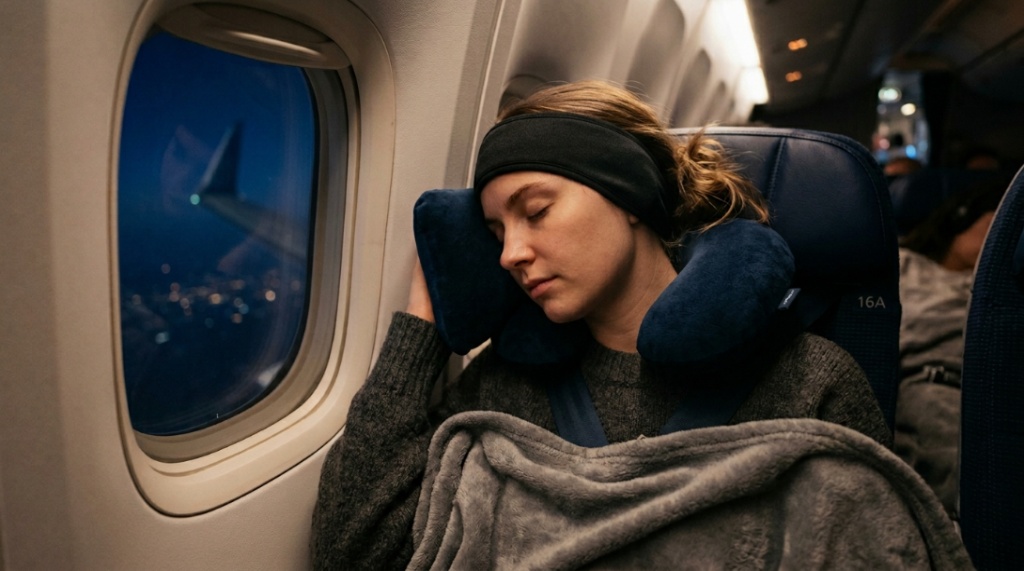
Sleeping on a plane with standard travel headphones means choosing between noise cancellation that requires uncomfortable over-ear cups pressing your head against a narrow headrest, or earbuds that jab into your ear canal the moment you lean sideways against the window. Travel sleep headphones solve both problems by delivering noise masking and comfort in form factors specifically designed for the bizarre sleeping positions aircraft seats force upon you — reclined but not flat, head tilted against walls or headrests, arms crossed or awkwardly positioned, surrounded by engine drone at 75–85 decibels for hours. Wireless sleep headphones for travel must handle what no normal sleep environment demands: non-horizontal sleeping positions, extreme ambient noise, and cabin pressure changes that affect ear seal.
Travel sleep headphones are wireless audio devices optimized for sleeping during transit — particularly long-haul flights, overnight trains, and bus journeys — combining noise masking or cancellation for high-ambient environments (75–85dB aircraft cabins), comfort during non-horizontal sleep positions (reclined seats, against windows), and battery life sufficient for 8–14 hour flights without mid-flight charging.
This guide focuses specifically on the travel-sleep use case — where environmental noise is louder, sleeping positions are stranger, and the consequences of choosing wrong mean 10 hours of failed sleep followed by jet-lag amplified exhaustion at your destination.
Why Are Travel Sleep Headphones Different from Home Sleep Headphones?
Travel environments create three challenges absent from home sleeping: extreme ambient noise (aircraft at 75–85dB vs. bedroom at 30–40dB), non-horizontal sleeping positions (reclined seats compress headphones differently than flat beds), and no charging access during use (10–14 hour flights with potential connections). Home sleep headphones optimized for quiet, horizontal, plug-in-nightly conditions fail in transit.
Travel vs. home sleep environment comparison:
| Challenge | Home Sleep | Travel Sleep | Implication for Headphone Choice |
|---|---|---|---|
| Ambient noise level | 30–40dB (quiet bedroom) | 75–85dB (aircraft cabin) | Need stronger noise isolation — passive isolation alone insufficient; ANC or powerful masking required |
| Sleeping position | Horizontal (flat bed) | Semi-reclined, tilted sideways against window/headrest | Must tolerate lateral head pressure against surfaces without pain |
| Session duration | 6–8 hours with overnight charging access | 8–16 hours with zero charging access | Need 10+ hour battery minimum, ideally 16+ for longest routes |
| Body position changes | Rolling side-to-side on flat surface | Shifting in seat, leaning left/right/forward | Must stay secure during seated position changes without manual readjustment |
| Temperature | Controlled bedroom temperature | Variable cabin temperature (often cold) | Headband-style provides warmth bonus; in-ear unaffected by temperature |
Which Sleep Headphone Types Work Best on Aircraft?
Sleep headbands with ANC-level masking sounds work best for economy/premium economy window seats (head leans against wall). Ultra-thin ANC earbuds work best for aisle/middle seats (head stays more vertical). Dedicated sleep earbuds (Bose Sleepbuds II) work for any seat but lack the noise-blocking power needed for louder aircraft environments without supplement.
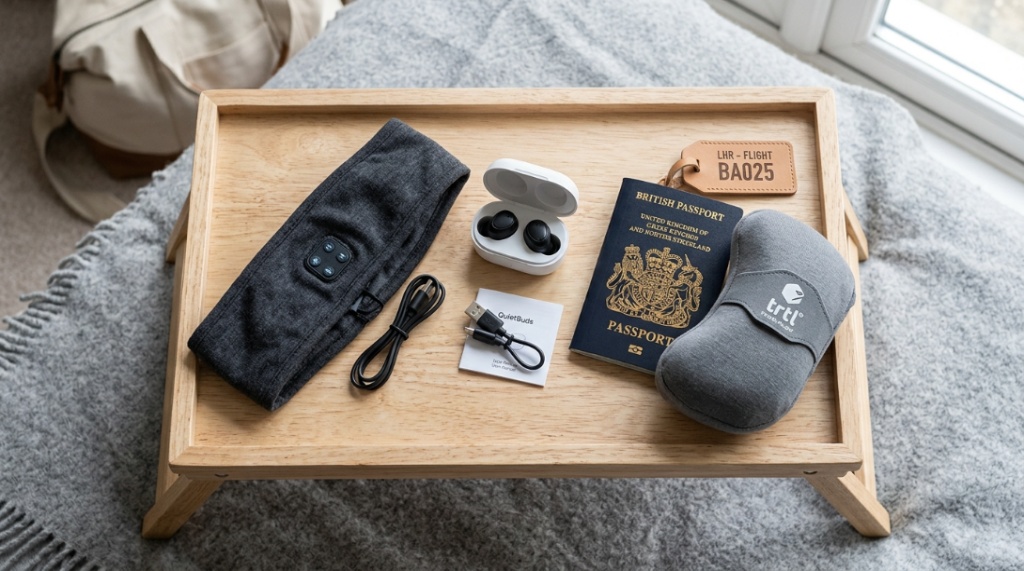
Aircraft-optimized options:
- Sleep headband + strong masking (window seats): Headband compresses comfortably against window wall/headrest. Fabric softness eliminates hard-surface pressure pain. Plays masking audio loud enough to cover engine drone. Combined with foam earplugs underneath for maximum isolation: the power combination for economy window sleep.
- Ultra-thin ANC earbuds (all seats): Active noise cancellation specifically targets the constant low-frequency engine drone that aircraft produce. Sealed fit provides 25–30dB passive isolation. ANC adds 15–20dB active reduction. Combined with masking audio: approaches the noise-blocking ability of expensive over-ear ANC headphones in a sleep-compatible form factor.
- Bose Sleepbuds II (moderate aircraft noise): Excellent comfort and dedicated sleep design but limited to built-in masking sounds at moderate volumes. May be insufficient for the loudest aircraft positions (over wing, rear of cabin) without supplemental foam earplugs for physical blocking.
- Hybrid approach — foam plugs + sleep headband: Budget option that’s surprisingly effective. Foam earplugs (NRR 33) block 15–20dB of engine frequency. Sleep headband plays masking audio over the remaining noise. Total cost: $25–$40 for both. Competitive effectiveness with $250 premium options.
For comprehensive travel-tested options with aircraft-specific noise reduction measurements, the wireless sleep headphones for travel guide ranks products by in-flight effectiveness from real passenger testing.
How Much Battery Life Do You Need for Travel Sleep?
Calculate your longest possible travel day (flight time + connections + delays + airport time) and add 25% buffer. Most long-haul travelers need 12–16 hours minimum. Ultra-long routes (Australia–Europe) with connections may need 20+ hours total — split across multiple charging opportunities at airports between flights.
Battery planning by travel scenario:
- Domestic flights (2–5 hours): Any sleep headphone with 6+ hour battery covers this easily. Charge at gate before boarding.
- Medium-haul (5–9 hours): 10+ hour battery preferred. Covers full flight without anxiety. Most dedicated sleep headphones meet this standard.
- Long-haul (9–14 hours): 14+ hour battery or quick-charge capability. Some flights offer USB charging at seats — verify your specific aircraft. If no in-seat power: need battery to last the entire flight.
- Ultra-long-haul with connections (16–24 hours total travel): 20+ hour battery ideal. Alternatively: charge during connection layovers (1–2 hours layover = near-full recharge on most sleep headphones). Plan charging stops.
Battery winners for travel sleep:
- QuietOn 3: 28 hours (ANC only, no audio playback) — covers any travel day
- SleepPhones Wireless: 12+ hours — covers most single flights
- Bose Sleepbuds II: 10 hours — adequate for single flights with pre-boarding charge
- Perytong headband: 10+ hours — budget option covering most routes
How Do You Sleep in a Plane Seat With Headphones Comfortably?
The key is matching headphone form factor to your seat-sleeping position: window leaners need pillow-side-compatible flat profiles, upright dozers need gravity-stable earbuds, and travel pillow users need headphones compatible with neck pillow contact patterns.
Position-specific comfort solutions:
- Window leaner (head against wall/window): Sleep headband works perfectly — soft fabric compresses against the window without creating hard pressure. Alternatively, ultra-flat earbuds in the window-side ear with nothing on the exposed side. Travel pillow against window adds cushioning layer.
- Upright dozer (head neutral or slightly reclined): Any earbud style works since no lateral pressure applies. Gravity is the only force — choose earbuds secure enough not to fall out when jaw relaxes during deep sleep (mouth opening changes ear canal shape slightly).
- Travel pillow user (U-shape around neck): Headband-style headphones may conflict with the pillow’s ear-adjacent sections. Ultra-thin earbuds work better with travel pillows because they don’t add bulk that prevents proper pillow positioning.
- Full recline (business/first class): Treat like home side-sleeping — any dedicated sleep headphone works in a flat or near-flat position. The premium you paid for the seat buys you normal sleep headphone compatibility.
Do You Need ANC for Sleeping on Planes?
Yes — for most travelers, some form of active or aggressive passive noise blocking is essential. Aircraft cabins generate 75–85dB of continuous noise that passive-only solutions can’t reduce enough for sleep-onset conditions. The constant engine drone sits perfectly in ANC’s strength zone (low frequency, consistent pattern), making ANC uniquely effective for this specific noise source.
ANC effectiveness in aircraft specifically:
- Engine drone (70–300Hz constant): ANC reduces by 20–30dB effectively. This is ANC’s ideal target — consistent, low-frequency, predictable. After ANC processing, engine noise drops from 80dB to 50–60dB — approaching sleep-possible levels.
- Cabin ventilation (200–2000Hz steady): ANC reduces by 10–20dB. Higher frequency components are partially addressed. Combined with masking audio, effectively neutralized.
- Passenger noise (variable): ANC provides 5–10dB reduction on intermittent sounds (conversation, announcements). Less effective than against constant noise. Masking audio covers the remainder more effectively than ANC for these sources.
For sleep specifically, the combination of ANC (handling engine drone) + masking audio (covering passenger noise) + passive isolation (physical barrier) creates the triple-layer approach that brings cabin noise from 80dB down to 30–40dB at your cochlea — threshold achievable for sleep onset.
While ultra-slim fabric headbands are perfect for side-sleepers, you might prefer a heavier premium brand if blocking out loud jet engine noise is your absolute top priority. If you want top-tier noise reduction but are mindful of your budget, you can Save Money on Bose QuietComfort Headphones Without Sacrificing Quality by looking for older models or certified refurbished pairs.
What About Cabin Pressure and Ear Comfort During Flight Sleep?
Sealed earbuds can create uncomfortable pressure sensations during altitude changes (takeoff, landing, turbulence-related pressure fluctuations). For flight sleep specifically, vented sleep earbuds or headband speakers avoid this issue entirely. If using sealed earbuds, remove during descent when pressure changes are most dramatic.
Pressure management for in-flight sleep:
- Sealed earbuds (slight pressure risk): The seal traps air at one cabin pressure. When cabin pressure changes (descent), the trapped air creates pressure differential felt as ear discomfort. Solution: remove during final 30 minutes of descent, or choose earbuds with pressure-equalizing vents.
- Vented earbuds (no pressure risk): Small vent channels allow pressure equalization. Slightly less noise isolation but zero pressure-related discomfort during altitude changes. QuietOn 3 includes pressure equalization specifically for flight use.
- Headband speakers (zero pressure risk): Nothing enters or seals the ear canal. Zero interaction with cabin pressure changes. The simplest solution for pressure-sensitive travelers.
What’s the Best Travel Sleep Headphone Kit for Long-Haul Flights?
The optimal kit combines: primary sleep headphones (ANC earbuds or headband), backup foam earplugs (in case batteries die or headphones become uncomfortable), a small power bank or charging cable for layovers, and a travel pillow compatible with your headphone choice. Total kit weight: under 200g plus pillow.
- Primary audio: QuietOn 3 or Bose Sleepbuds II — lightweight, long battery, purpose-designed for sleep
- Backup isolation: Foam earplugs (NRR 33) — weighs nothing, always works, zero battery dependency. $2 for a pack of 10.
- Power: Short USB-C cable + awareness of seat power availability — charge during layovers or from seat USB if available
- Comfort: Travel pillow compatible with headphone positioning — inflatable types pack smallest; memory foam types feel best
- Eye mask: Blocks visual stimulation independently of headphones — light blocking + audio blocking = maximum sleep potential
This complete kit fits in a small pouch (total weight under 300g including pillow) and covers every sleep scenario from smooth direct flights to disrupted multi-connection nightmare itineraries.
Conclusion
Travel sleep headphones face demands that home sleep headphones never encounter: extreme ambient noise (75–85dB aircraft engines), non-horizontal sleeping positions, zero-charging marathon durations, and cabin pressure complications. Choose ANC-capable options (QuietOn 3, or combination approach with foam plugs + headband) that deliver 12+ hour battery life and form factors compatible with your specific seat-sleeping position. The hybrid approach (foam earplugs for physical blocking + sleep headband for masking audio) offers budget-friendly effectiveness rivaling premium dedicated products. Pack backup foam earplugs regardless of your primary choice — reliable sleep on long flights is too valuable to risk on a single-point-of-failure system.
Compare travel-tested sleep headphone options with in-flight effectiveness ratings at the travel sleep headphones guide — ranked by aircraft noise reduction and long-haul battery endurance.
What’s your longest upcoming flight and which seat position do you usually sleep in? Share in the comments for targeted travel sleep headphone recommendations matched to your specific route and sleeping habits.
Frequently Asked Questions
Can you use sleep headphones during takeoff and landing?
Wireless Bluetooth headphones must typically be in airplane mode during taxi, takeoff, and landing on many carriers (rules vary by airline). Some airlines now allow Bluetooth throughout the flight. Check your specific airline’s policy. Wired sleep headphones or foam earplugs have no restrictions at any flight phase.
Are Bose Sleepbuds II good enough for airplane noise?
For most cabin positions, yes — their passive isolation combined with masking sounds handles typical cruise-altitude noise adequately. For seats near engines (over-wing, rear cabin) where noise reaches 82–85dB, they may be insufficient alone. Supplement with foam earplugs underneath for maximum isolation in the loudest positions.
What if my sleep headphones die mid-flight?
Always carry backup foam earplugs ($2 investment). They provide 20–25dB of passive isolation regardless of battery status. Combined with your airline’s free blanket over your head (blocks additional noise), this backup system provides acceptable sleep conditions until landing. Never depend solely on battery-powered devices for flight sleep.
Do travel sleep headphones work for trains and buses too?
Yes — trains and buses are actually easier environments than aircraft (lower ambient noise levels: 60–75dB vs. 75–85dB on planes). Sleep headphones effective for aircraft handle train/bus environments easily. The same products work across all transit types without modification.
Should I buy ANC travel headphones or dedicated sleep headphones for flights?
If you ONLY need them for sleeping: dedicated sleep headphones (Bose Sleepbuds, QuietOn) provide better comfort during sleep despite less total noise cancellation. If you need headphones for both awake listening AND sleep on the same flight: premium ANC earbuds (Sony WF-1000XM5, Jabra Elite) handle both use cases in one product, though with comfort compromise during sleep portions.
How do I keep sleep earbuds from falling out on a plane?
Use memory foam ear tips (grip better than silicone during jaw relaxation), choose the correct size (slightly larger = more friction), and consider a light headband or beanie worn over ears to provide secondary retention. Sleep earbuds designed for sleeping (Bose Sleepbuds) include retention features that standard earbuds lack — their wing-tips or friction coating specifically prevent gravity-based fallout during position changes.
What’s the best budget travel sleep headphone?
The Perytong Bluetooth sleep headband ($16–$25) combined with foam earplugs underneath ($2) provides effective travel sleep audio for under $30 total. The foam plugs block engine noise physically; the headband plays masking audio over remaining noise. This budget combination approaches the effectiveness of dedicated $250 products at roughly 10% of the cost.